Sustainability initiatives at LAB42
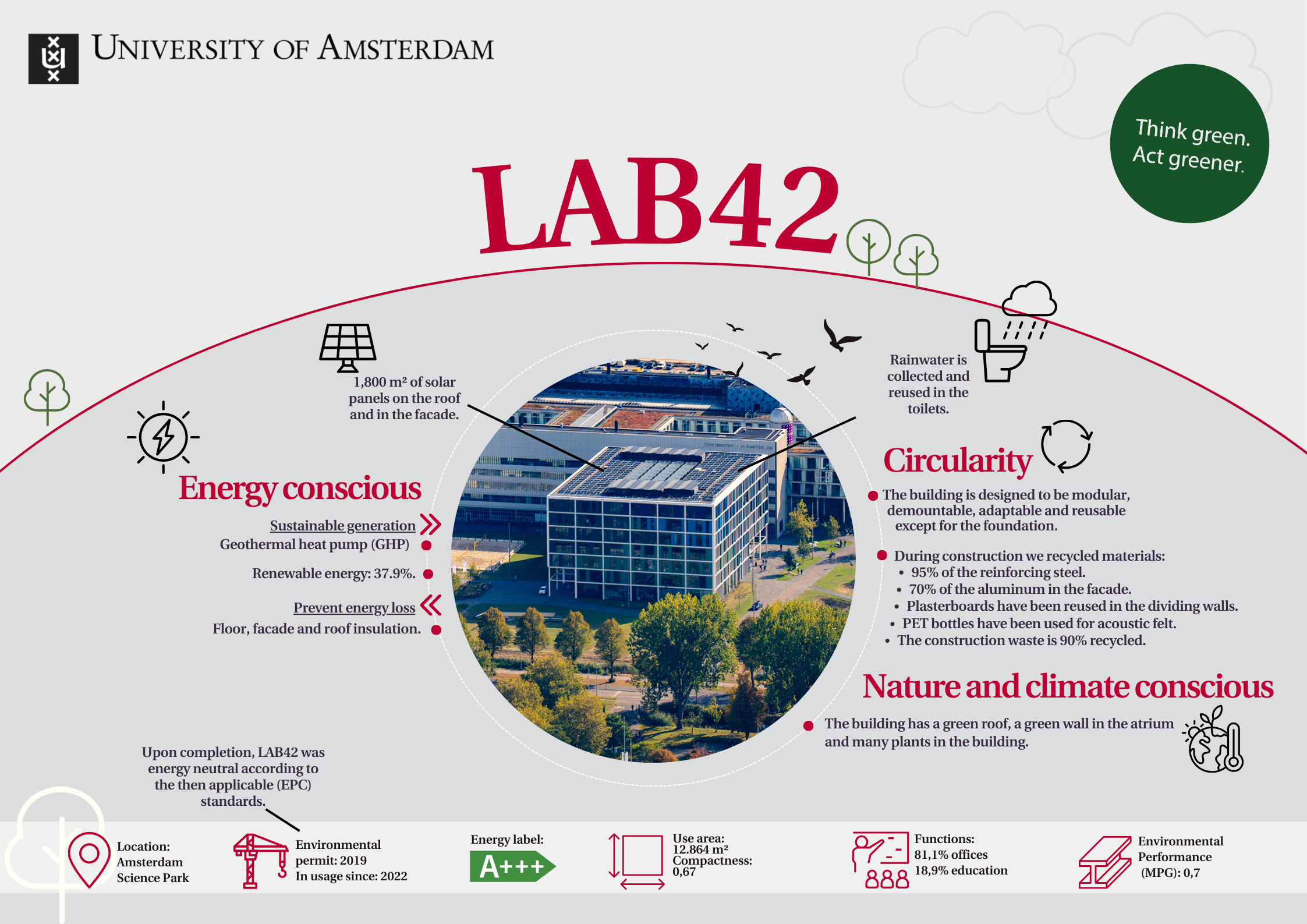
Discover how LAB42 was designed to be circular, energy-conscious, and environmentally friendly: from solar panels on the facade and roof to the reuse of materials and smart energy storage. This infographic shows how the building contributes to future-proof campus development.
Solar panels: a nod to informatics
Around 1800 m2 of solar panels are installed on the roof and in the façades. The southwest façade has a pattern of open and closed panels that converge towards the top of the building and refers to a binary code, as a nod to the informatics taught in the building. Parts of the closed panels consist of solar panels, which can also be reused in the future. In order to place solar panels over the entire roof surface, the air-conditioning units that would normally be located on the roof have been moved to a lower floor. Solar cells are even incorporated into the glass of the skylights/roof windows.
The building has a geothermal heat pump (GHP) system and CO2 reduction and is given a retention roof that collects rainwater (reducing the burden on drains), subsequently reused for flushing toilets in the building.
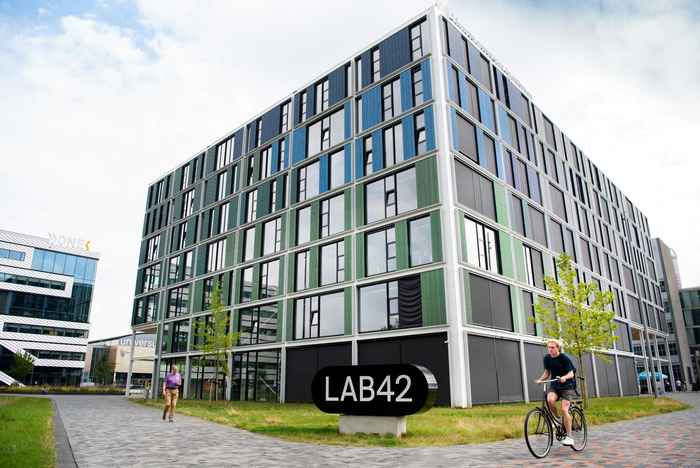
Winner of the European Steel Design Award for Sustainability 2025
The jury praised the building for its energy-neutral, fully demountable construction, which guarantees long-term flexibility and sustainability.
Read more
Winner of the 2024 National Steel Award
The jury praised LAB42 for its ambitious sustainability and future-proofing ambitions.
Read more
Circular and flexible
The support structure of LAB42 is circular and consists of a 100% reusable steel structure that serves as a rack. The steel structure will be easy to adapt and reconfigure in line with future changes.
No unnecessary material is used in LAB42 to conceal or close the structure. The material that is used in addition to the construction is sustainable; for example, felt from recycled PET bottles is deployed in the form of panels to promote the acoustics. Reused products and materials that are used: reused revolving doors, circular inner walls – a significant percentage of the wall is made of used plasterboard, although the visible plasterboard is new. Reused wooden laminated beams, work floor of recycled concrete, recycled cable ducts, fire hose reels and connection cables. The furniture also consists of reused materials.
Consolidation points register the number of occupants so that the lighting, air, temperature and comfort can be easily adjusted to the number of people in the teaching rooms and offices.
Healthy
The skylights allow daylight to enter the atrium from above. The atrium forms the centre of the building, with plenty of light and greenery. This ensures a pleasant indoor climate and therefore a healthy working environment for students, staff and companies. The light atrium that runs diagonally through the entire building, playful mezzanines, connecting walkway and varied work landscapes ensure a structure that is clear and well organised but also dynamic and inspiring. A subdivision is made into three clearly recognisable areas, from concentration zones to places in which meeting and discovery take centre stage, and enables optimal cross-pollination between the various disciplines. In addition, the design also encourages people to climb stairs.
Smart
Consolidation points register the number of occupants so that the lighting, air, temperature and comfort can be easily adjusted to the number of people in the teaching rooms and offices.